
Which Half is Horse?

A few things I noticed recently about AI and what it means to be human.
Amodeis ex machina
Look, I’m not saying that the sibling co-founders of Anthropic and creators of Claude definitely read my little Substack. But here’s Dario Amodei recently talking about how we’re in a “centaur phase” – a time when human-AI teams outperform either working alone – and how it won’t last long, which I wrote about here. And then here’s Daniela Amodei talking about how important studying the humanities will be as AI permeates more of our lives and work. “In a world where AI is very smart and capable of doing so many things,” she said, “the things that make us human will become much more important.” She also listed the “soft skills,” like empathy, communication, and critical thinking, that Anthropic looks for when hiring.
They’re really talking about two perspectives on the same phenomenon: one that sees what AI advancement will displace, particularly with jobs, and the other that sees what we can do to fill those voids as this happens.
The question is whether we’re ok with that tradeoff, especially as the market value of arts and humanities training remains unproven.
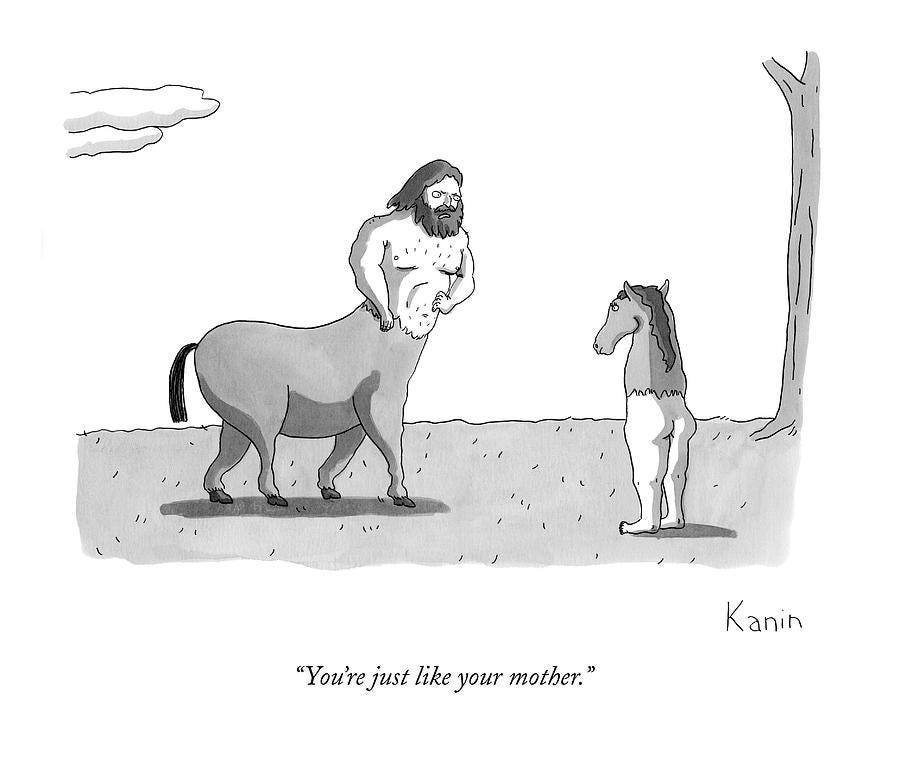
Which half is horse?
Sci-fi writer and activist (and fellow Cory) Cory Doctorow wrote about this tradeoff recently. He invokes “centaurs,” too, along with their opposite, “reverse centaurs.” If the former is a person augmented by machines, the latter is “a machine that is assisted by a human being, who is expected to work at the machine’s pace.” He cites an example from the Chicago Sun-Times, where a newsroom full of interns, journalists, and fact-checkers were replaced by one freelancer with access to AI. That freelancer oversaw the production of a majority of the 10 “Best of Summer Lists” published by the paper. In the “Summer Reading Guide,” as published, 10 of the 15 books listed did not exist at all. They were AI hallucinations, pushed out by chatbots that can work faster and looser than one single human if not kept in check.
Maybe we shouldn’t expect one person to do the work of 50, regardless of the tools at their disposal.
On tech, as much as it may seem like we’re at the whims of larger forces, Doctorow says “there’s nothing inevitable about it.” Meaning us centaurs still have some agency to decide which half is horse (so to speak).
When toil isn’t trouble
Ella Markianos, a reporter at the tech blog Platformer, provides a case in point. She built a Claude-based agent she called “Claudella” and tested whether it could do her job.
In some ways, it could. Claudella was good at finding quotes Markianos may have missed. It also came close to mimicking her voice and wrote solid pieces after a few rounds of feedback. But it couldn’t land a joke, got erratic when given editorial feedback, and showed a favorable bias toward Anthropic when writing about AI topics (an understandable piousness towards one’s maker, maybe).
The experiment led Markianos to reflect on her writing process and how her thinking unfolds and clarifies through the drafting itself. “If I had Claude write my first drafts,” she writes, “even if I fact-checked them thoroughly, it would be a lot harder to tell whether the angle was my own view or the AI’s.” Her enthusiasm for the field also started to deflate. She enjoys the “drudge work” of deep research and iterative drafting, and seems less enthused by the interpersonal aspects of reporting that AI won’t replace anytime soon, such as talking to sources and networking with other reporters.
I find this latter reflection fascinating and challenging to my own assumptions and biases: what about people who don’t want to be more social, more connected? If some kind of prescribed way of “being more human” becomes the only solid answer to AI, for some, that could become its own kind of drudgery.