
An Immodest Proposal

“You know what I’d like to offload,” an Executive Director said the other day, “is dealing with my freaking board.” We were at a summit on the creative workforce, talking between panels about what AI could take off people’s plates. The conversation had been about admin, proposal writing, the usual time drains. Then the ED dropped that bomb about boards. Heads nodded, gripes were griped. It became a kind of support group for nonprofit leaders who felt saddled with a structural norm that often didn’t seem worth the effort. The difficult personalities, the prep materials that went unread, the travel planning multiple times a year.
It made me think about how I’ve been using AI lately as a kind of virtual advisory board. I’ll ask Claude Code to spin up a series of different personas (called “subagents” in AI lingo) to review what I’ve built or plan to build. I’ll ask for a designer to look at the user experience, a product manager to assess how all the elements fit together, a marketing guru to think about positioning. They’ll provide individual reports that Claude then distills to areas of overlap and unique opportunities from each perspective. I’m not fooling myself into believing that these are real experts; it’s all an amalgamation of what the LLM has gathered through its training data. But the feedback has been consistently helpful and often surprising. As a soloist, it’s a great way to bring in a proxy for outside perspectives, without having to set up catering.
I floated the idea that maybe AI should replace our boards, not our junior workers. It was an immodest proposal, one that got some laughter, some wistful sighs. But the threat of AI-related job displacement always points downward to people already at a disadvantage. Many are navigating financial insecurity, student loan debt1, and uncertainty about where their skills fit. Board members, meanwhile, tend to sit comfortably in their wealth and careers. And yet, if you told a director to cut costs, how many would think to fire their board?
Hearing those nonprofit leaders at the summit reminded me of a Museum Board Leadership research project I led in 2024, in partnership with the American Alliance of Museums (AAM). In it, we surveyed over 400 museum directors about their relationships with their boards, and found a lot of the same kinds of dissatisfaction. Now, there are plenty of good boards and committed board members out there. The best of them deliver on what I’ll call the “3 Gs”: guidance (i.e., providing expertise in areas that supplement and support leadership), governance (i.e., keeping the org to its legal, fiduciary, and ethical responsibilities), and gifts (i.e., fundraising).
But even effective boards take a lot of management. First, many meet a lot. Take a look:
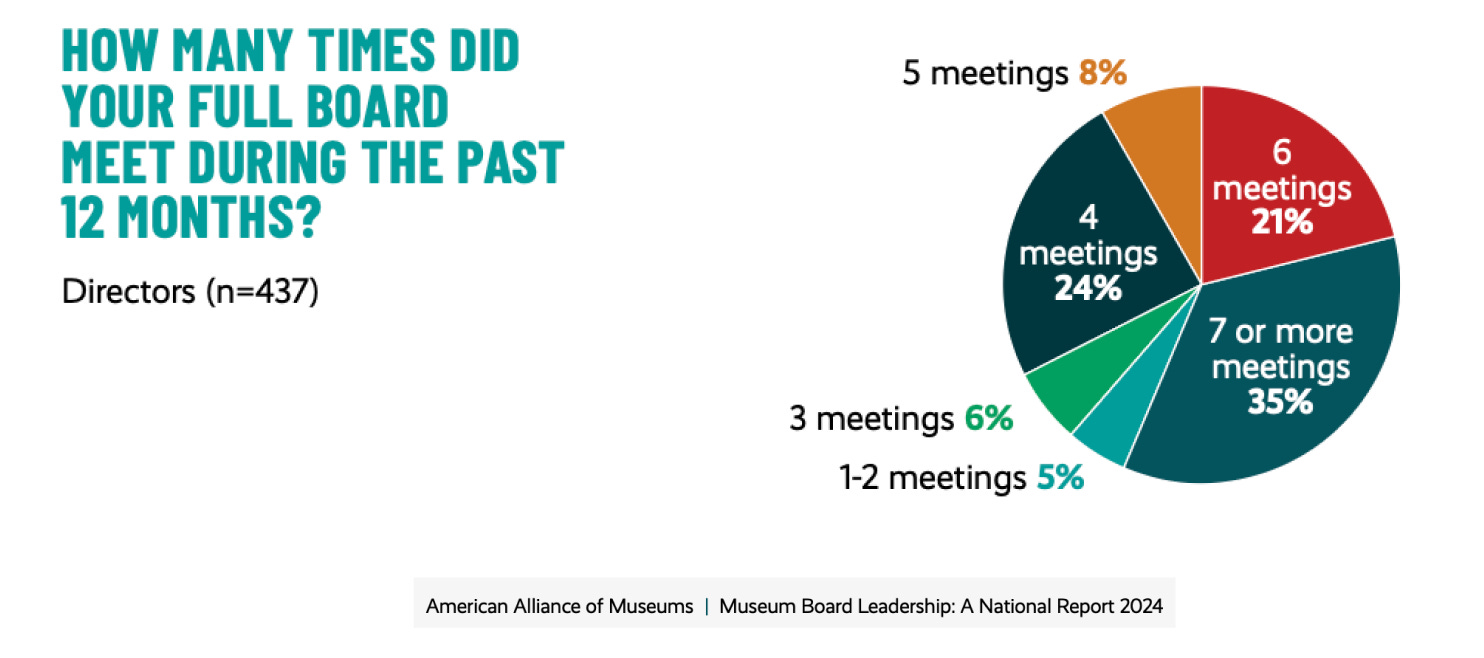
A vast majority of museum boards, 88%, meet four or more times per year. Over a third (35%) meet seven or more times! And that’s just the formal board meetings, not the full slate of ongoing board interactions.
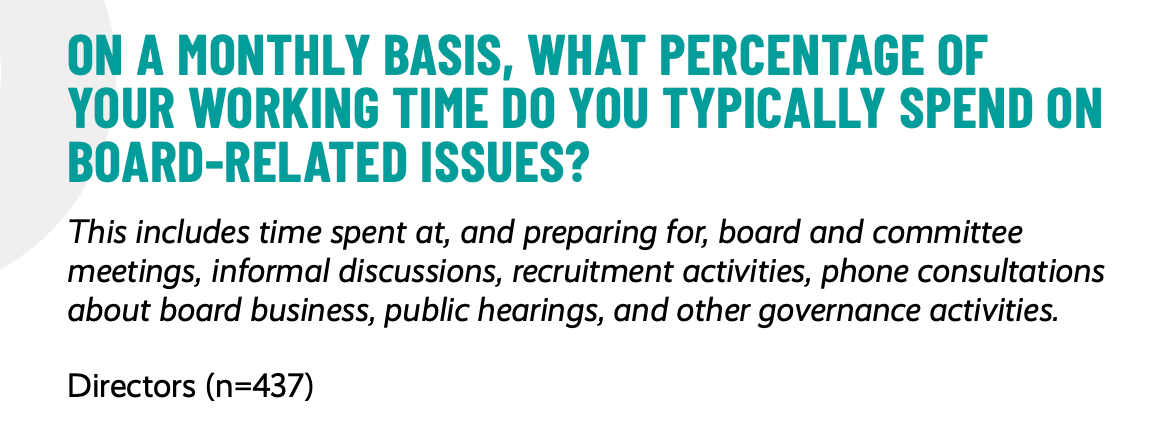
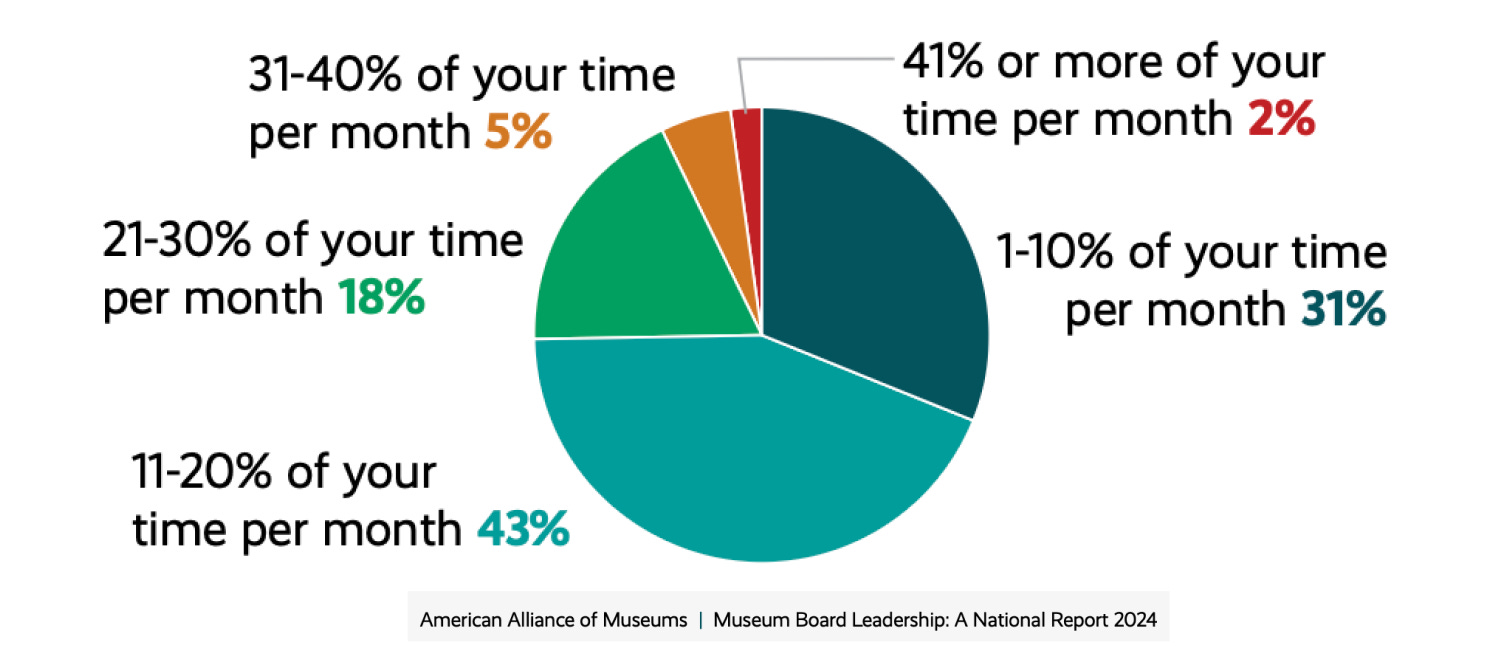
Close to half (43%) of directors spend between 11-20% of their time on board-related issues. In a 40-hour week (LOL), that’s roughly a full day. And a quarter of directors spend even more.
Ok, that’s all the math, English majors, I promise. One more graphic, though. We asked directors to grade their board’s performance, and boards to grade themselves. The average grades aren’t particularly impressive.
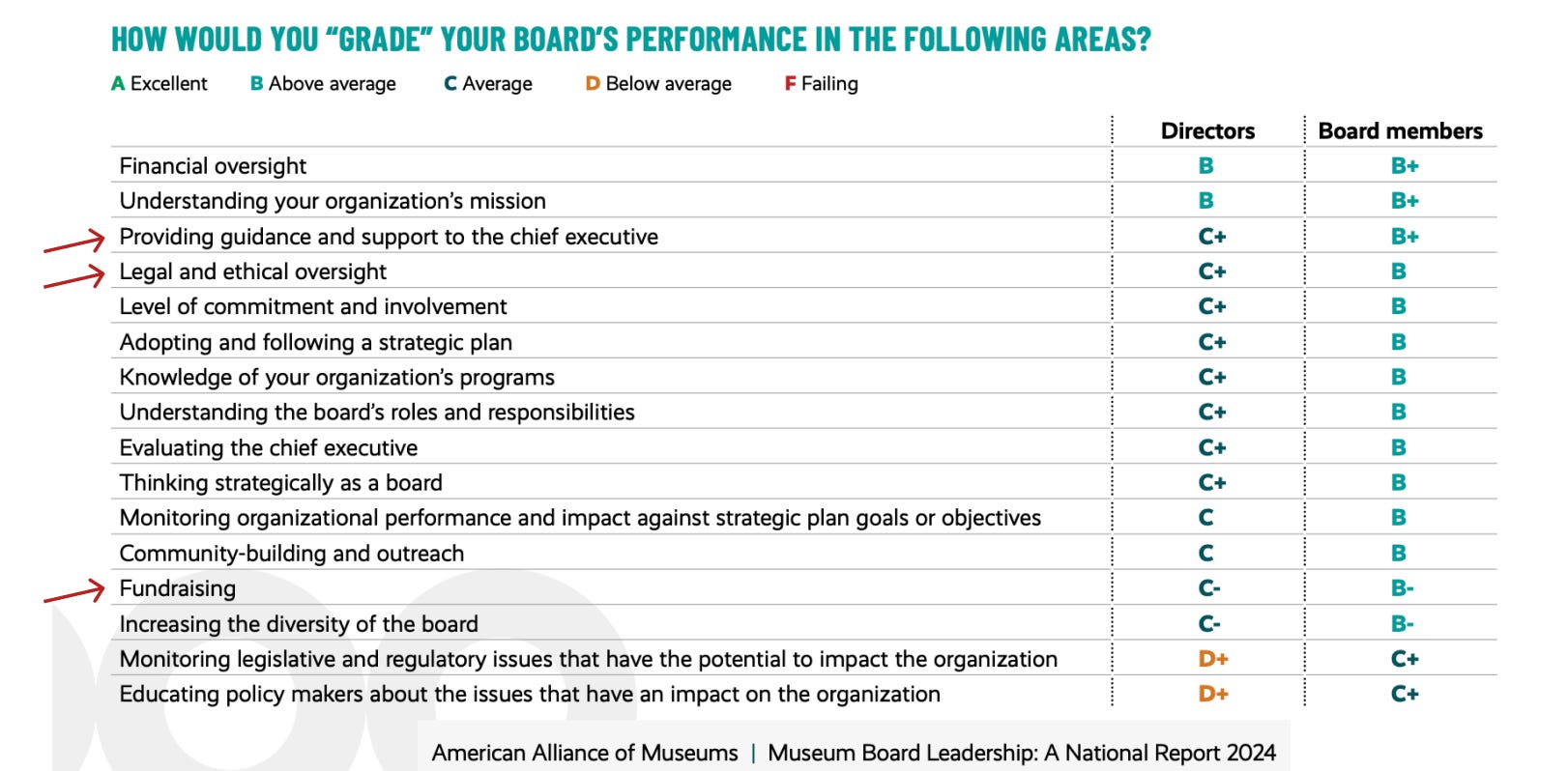
There’s a lot there to take in, but a few lines stand out: a C+ on providing guidance and support to the director/CEO, a C+ on legal and ethical oversight, and a C- on fundraising. That’s a lot of Cs on the 3 Gs (guidance, governance, and gifts).2
This doesn’t mean most boards are awful. It’s just that, for the time and effort spent on them, many directors aren’t seeing the ROI. There’s important work already being done on this front, and on the necessary diversification of boards, by groups like AAM and the Black Trustee Alliance for Art Museums. But the burden remains on directors and their staff to keep their boards informed, engaged, and pulling in the same direction.
Here’s where AI can genuinely be useful and make the experience less taxing. Board books alone, with their detailed agendas, departmental updates, and budgets formatted for easy scanning, take a ton of stressful hours to assemble. AI can do much of that in an afternoon. Same with post-meeting summaries, donor outreach plans, and other follow-ups on action items.
Ultimately, what I heard from those nonprofit leaders at the summit wasn’t really a desire for abolishing boards or replacing them with bots. It was resentment that too much of their energy flows upward to the people who should be supporting them, instead of inward to staff or outward to communities.
So don’t actually fire your board, or your junior employees, for that matter. Just “hire” some AI agents to do the grunt work and claim back time to do the work that actually matters to you.
When asked what one thing they’d change on a policy level to help the creative class, one panelist said “Portable benefits,” since so many work job to job. You know what is eminently portable, though? Debt.
Perhaps unsurprisingly, board members graded themselves much higher across the board (so to speak).